
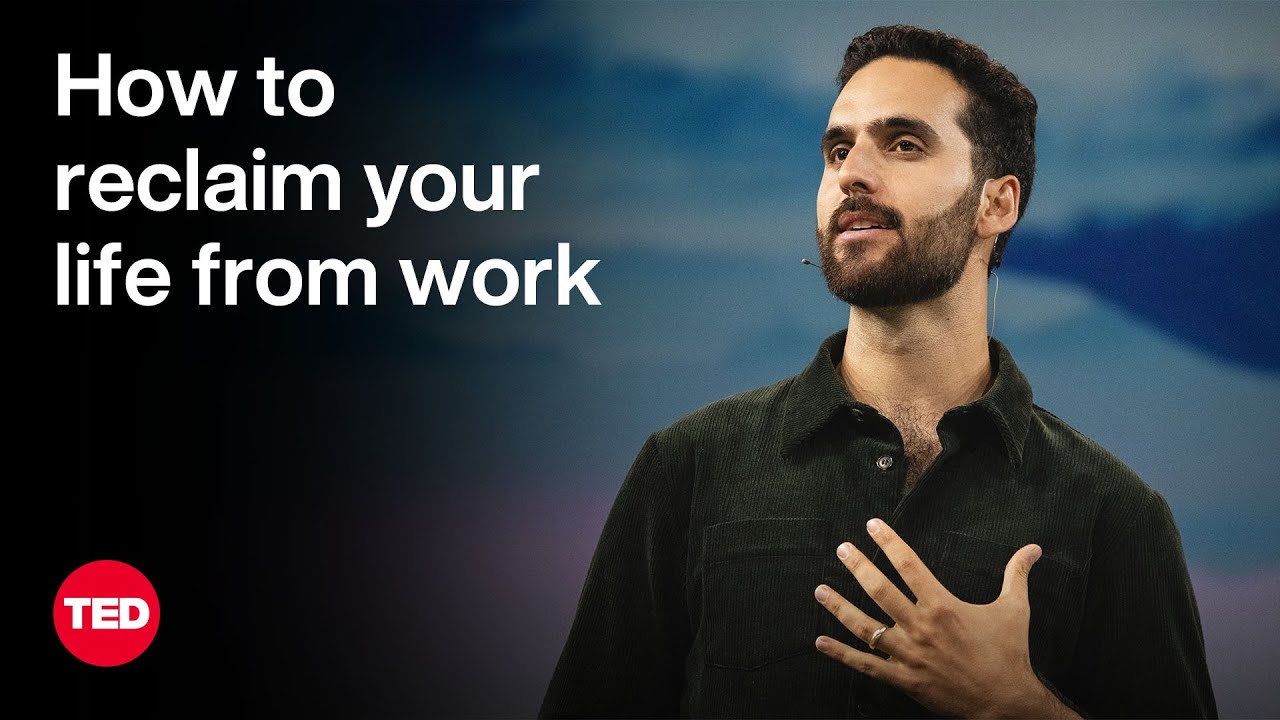
This TED Talk Simone Stolzoff explores how modern work culture ties our identity too closely to our jobs, why this leads to burnout, and how reclaiming life outside of work can help us live with greater balance and meaning. The insights shared in this TED Talk Simone Stolzoff are invaluable for anyone seeking a healthier work-life balance. In this TED Talk Simone Stolzoff, Simone emphasizes the importance of prioritizing personal well-being over job titles.
How to Reclaim Your Life From Work
In this section, you’ll learn how work shapes identity, why this can lead to burnout, and simple ideas for reclaiming life beyond work.
Insights from the TED Talk Simone Stolzoff
In his TED Talk Simone Stolzoff, him shares various strategies to detach our self-worth from our careers.
Simone Stolzoff | TED
I once met a Chilean guy at a hostel. When I asked him, “So what do you do?”, he replied, “You mean for work?” as if I had just asked him something deeply personal. In the United States, “What do you do?” is often the first question we ask when meeting someone new. From a very young age, we are taught to conflate who we are with what we do, already blending our identity with our job, as if they were exactly the same thing.
I think about this a lot. I’m a labor journalist, and I wrote a book called The Good Enough Job, based on conversations with more than one hundred people about the relationship between their work and their sense of self. But before that, I was just a 22-year-old poetry student, trying to figure out who I wanted to become and what role work would play in my life.
Around that time, I interviewed my favorite poet, Anis Mojgani, and I asked him what he thought about the mantra, “Do what you love and you’ll never work a day in your life.” He told me that some people do what they love for work, while others do what they have to do so they can enjoy what they love outside of work, and that neither path is more noble than the other. Hearing this from a professional poet made me realize that having a day job is not a failure. Today, nearly half of workers around the world report feeling burnt out. Yet burnout isn’t solved by a one-week vacation or better self-care routines. These quick fixes fail because they don’t address the root cause. If we want a healthier relationship with work, we can’t only focus on managing time better. We need to rethink how much of our identity we allow work to occupy.
We are more than just workers. We are parents, friends, citizens, artists, neighbors, and members of a community. Just as investors benefit from diversifying their portfolios, we benefit from diversifying the sources of meaning in our lives. One way to do this is by creating time sanctuaries, moments when work is simply not allowed to enter.
These time sanctuaries require structure, not just good intentions. It might mean putting personal activities on your calendar, turning your phone to airplane mode, or protecting small parts of your day from work. These actions don’t need to be impressive or ambitious. A short walk with a friend or a few minutes practicing an instrument can be enough to reconnect with parts of yourself outside of work.
Another important step is joining communities that don’t care what you do for a living. For me, that’s a weekly pickup basketball game. No one there cares about my job or my achievements. They care that I show up, play fairly, and support my teammates. It’s a simple reminder that my value isn’t measured only by productivity or economic value. Ironically, having a more diverse identity can even make us better at work. Research shows that people with varied interests tend to be more creative and resilient. This matters especially during difficult moments like a layoff or an economic downturn. If your entire identity is built around your job, losing it can feel like losing yourself.
The insights from the TED Talk Simone Stolzoff reiterate that our varied identities enhance our professional capabilities. But this isn’t only about productivity. It’s about becoming better people, building stronger relationships, and teaching the next generation that self-worth isn’t defined by a job title. Not all meaningful contributions can be listed on a resume, and not all valuable work benefits an organization’s bottom line.
So the next time you meet someone, instead of asking, “What do you do?”, try asking, “What do you like to do?” That small change opens the door for people to define themselves on their own terms, not just through their work.
